Full Awareness of Breathing
Buena Vista Sangha teaches Ānāpānasati, Full Awareness of Breathing, as the introductory method for everyone joining our group meditation community, even if they have practiced other methods of meditation for years. There are several reasons for this:
Gautama Buddha himself taught Ānāpānasati as a foundational method
It is universal, we all breathe
It requires no specific beliefs and is compatible with one’s religious or philosophical views
It can be practiced anywhere at any time
As such, it is foundational to mindfulness practice
It gives us a common experiential point of reference, which facilitates discussion and understanding
It gives us a common foundation from which to explore other helpful meditation methods
It is fundamental to deepening silence and clarity crucial to deeper insight
It is simple, natural and easily learned
It gives us a common method for group practice
It works!
Ānāpānasati in the Broader Context
Forms of Meditation
There are many forms of meditation but, broadly speaking, they fall into two main categories:
Calming meditation - Samatha (Pāli; Sanskrit: śamatha शमथ; Chinese: 止; pinyin: zhǐ), calm-abiding, serenity, tranquility, or calming meditation
Insight meditation - Vipassanā (Pāli; Sanskrit: vipaśyanā विपश्यना), literally special, super (vi-), seeing (-passanā)" or insight meditation
Samatha meditation can enable us to reach a deeper level of relaxation than sleep. Relaxation leads to mental stability and clarity.
Vipassana meditation leverages the ease of body and mind, and the mental clarity produced by Samatha meditation. We have a stable foundation to use methods that lead to deeper insight into the cause of our afflictions and suffering.
Origins
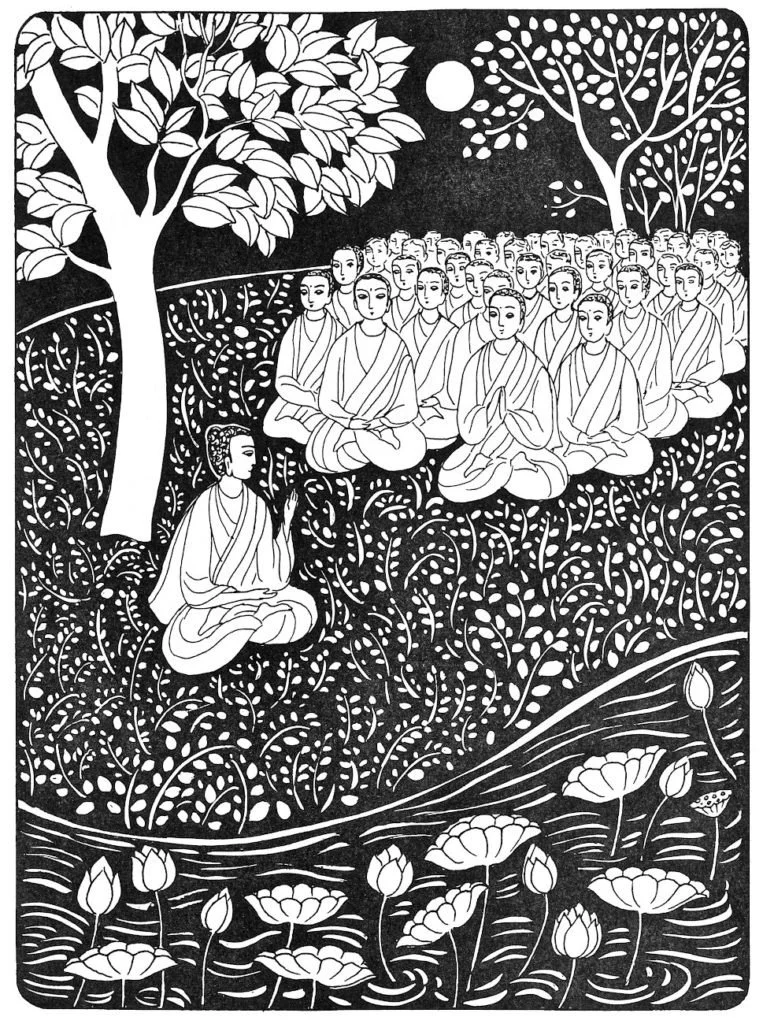
In the Theravada tradition, the oldest Buddhist tradition continuously practiced since the time of Gautama Buddha, beginning meditators are first taught how to calm the mind. Buddha himself taught Ānāpānasati, as documented in the Ānāpānasati Sutta (from the Pali Canon Majjhima Nikaya 118). Ānāpānasati is a Pali word (Sanskrit: ānāpānasmṛti), meaning full awareness of breathing. Sati means mindfulness, to remember, or full awareness; ānāpāna refers to inhalation and exhalation. Anapanasati, or following the breath, has long been considered the quintessential samatha meditation method.
Subsequent Buddhist traditions, such as the Chinese Caodong Chan school and Japanese Soto Zen school adapted the method of following the breath as a foundational method.
Note: Chán 禪 is a short form of chánnà 禪那 from Sanskrit dhyāna, meaning meditation or meditative state. The word Zen was a Japanese transliteration of the Chinese word Chán.
How to Practice
Sit comfortably on a chair or meditation cushion. Back should be erect but relaxed. Find the point where vertebrae are effortlessly balanced like a stack of cups.
Rest fingers of on hand on fingers of the other, thumbs lightly touching, on your lap. If on a chair, hands palm down on thighs near knee.
Tongue lightly touching back of upper front teeth near palate.
Facial muscles relaxed. Eyes gaze unfocused a few feet in front.
Start at the top of the body and work your way down, relaxing any tension you feel in the scalp, facial muscles, neck , shoulders, arms, hands, back, abdomen, hips, thighs, calves and feet.
Shift awareness to your breath. First notice the overall sensation of breathing in and breathing out. Breath in fully and exhale a few times.
Shift awareness to your abdomen as you continue to breathe naturally, noticing the rise and fall of the abdomen. This is the recommended method. Or, if you prefer, notice the air coming into and out of the nostrils.
Continue to follow the breath.
If thoughts or sensations occur, when you realize you are not on the method, just gently return to following the breath.
Tips for Staying with the Breath
It greatly helps to develop an appreciation for the soothing, life-giving quality of the breath. This helps retain a fascination for each inhalation and exhalation.
If mind is repeatedly drifting, note how each inhale has a beginning, middle and end. Each exhale has a beginning, middle and end. See if you can note the exact time it switches from inhalation to exhalation and visa-versa.
Realize that thoughts are natural. The mind thinks thoughts. These are not an impediment to continuing to follow the breath. We don’t latch on to thoughts and we don’t push them away. Just, when we notice we are having a thought, we again gently shift awareness back to the glorious quality of each breath with renewed appreciation.
If we feel drowsy and our eyes have closed, open the eyes. Take a couple deep breaths and then continue breathing naturally.
Notice every facet of the breath, how the abdomen is moving, whether the breath is fast, shallow, long, deep, etc.
Develop a sense of surrender. Just let go of whatever is arising. You can put it down for awhile, whatever it is, and after meditation, if it is important, you can pick it back up and deal with it then. Just let go.
Just relax.
Effect of Staying with the Breath
Breathing may slow down, becoming longer and more drawn out
The breath feels very soothing
Thoughts become less frequent or subside completely
Awareness may be less contracted, become more spacious, broader, take in more of the environment
A sense of well-being, deep contentment, lightness and bliss may develop
An awareness of deep silence may become apparent
There may be gaps in the continuum of experience
Time may pass quickly
Awareness may be encompassing, pervasive or ubiquitous
The mind is balanced, effortlessly focused on the method of just following the breath
When to Let Go of Following the Breath
If you feel that you are effortlessly staying with the breath and few thoughts are coming and going and you are no longer following streams of thoughts, if following the breath feels redundant and the mind is bright, open and clear, you can let go of following the breath and just sit. If the mind needs an anchor, just sit with an overall awareness of the body sitting in your environment. Relax with bright, open, clear awareness not focused on any particular thing, aware of whatever is arising and passing in awareness. Relax into deepening silence and broadening awareness with clarity. This is the beginning of Silent Illumination practice, also described as The Method of No Method or Just Sitting. This will be covered in a subsequent post.
Ending Your Practice Session
After your meditation session has ended:
Always take a couple minutes to come out of meditation. You may be deeper than you are aware and it can be very jarring to spring up after meditation. Things can wait.
This is great time to practice Metta Meditation for a few minutes, wishing everyone health and happiness. This will be covered in another post.
It is always advisable to massage the body after meditation. Start at the scalp and massage the face, around the eyes, the neck, shoulders, upper arms, forearms, hands, chest, abdomen, back, lower back, hips, thighs, calves, ankles and feet.
Carry your settled clarity into activity. Take the time during the day to stop, settle, regain clarity. This only takes a moment. This can be done anywhere, as often as needed as you continue your day.
Further Reading
Discourse on the Full Awareness of Breathing - Thich Nhat Hanh
The Method of No-Method: The Chan Practice of Silent Illumination - Chan Master Sheng-yen
Illumination: A Guide to the Buddhist Method of No-Method - Rebecca Li