
Session 2 of 4)
Silent Illumination (Chinese: 黙照禅, pinyin: Mòzhào, Japanese: Shikantaza) is a principal meditation practice of the Cáodòng (曹洞, Soto) school of Chán (禪, Zen) Buddhism. It integrates both calming (śamatha) meditation and insight (vipaśyanā) meditation. Chan Master Sheng-yen described this as a practice that can take one the full way to enlightenment. Referred to as “the method of no method” or “just sitting”, it is extremely simple, natural and almost completely effortless, but amazingly rewarding and beneficial.

Chan (Zen) Chinese character
We will begin with “full awareness of breathing” Ānāpānasati (Pali; Sanskrit: ānāpānasmṛti), which provides an anchor, the rise and fall of the abdomen during natural breathing, on which to focus. Once the mind is settled and able to stay with the breath, we relax into a full awareness of sitting in our environment. This sets up the perfect condition for insight into the essential nature of our own awareness.
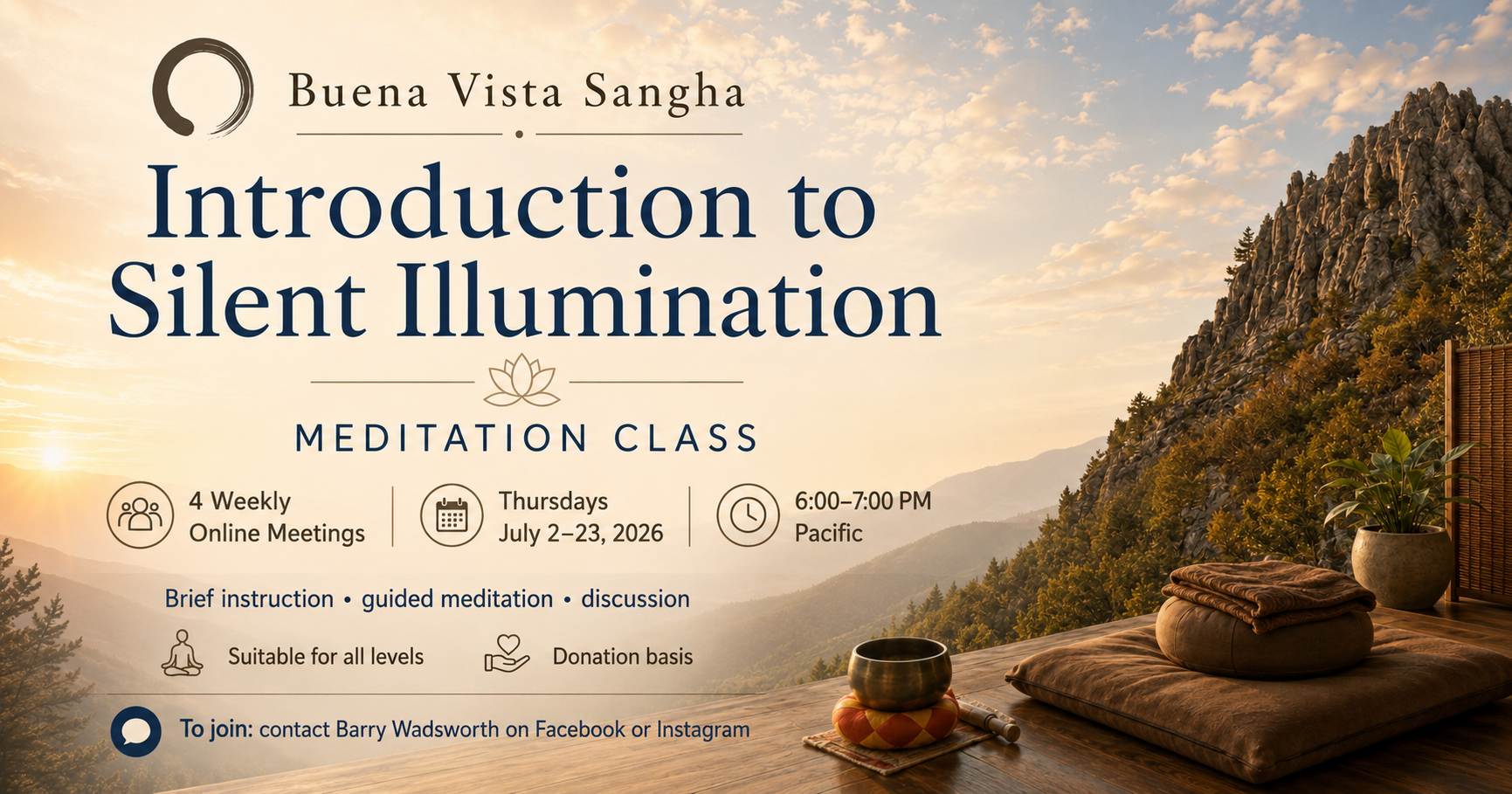
This initial offering will be over a four week period meeting on Thursday evenings at 6:00 PM Pacific. It will include brief instruction, short guided meditations, and discussion. It is suitable for people of all levels of experience, from beginners to advanced meditators. Please plan on practicing what is taught in this class for 20 - 30 minutes per day during the duration of the four weeks.
This is offered on a donation basis. To make a donation, please click the Donate button below.
IMPORTANT
You need a Zoom account (free) because you will be required to login to Zoom to attend the meeting.
You must first register to join these sessions. Register here:
To be notified of future events, please click the Join menu item at the top of the page, or click here.
Questions? Please contact Barry Wadsworth on Facebook or Instagram.

Introduction to Silent Illumination - Meeting Summary
Thursday July 9, 6:00 - 7:00 PM
Quick recap
This was a meditation group session led by Barry where participants shared their experiences with following the breath meditation practice from the previous week. Cynthia discussed her challenges returning to meditation after a decade away, while Brenda managed to meditate for 10 minutes despite finding it difficult to sit still. Emily shared her preference for lying down meditation due to sciatica issues, though she noted falling asleep was a challenge. Alicia mentioned successfully meditating outside but struggling with distractions from traffic and to-do lists. Barry then guided the group through a combined breath following and silent illumination meditation practice, explaining the difference between calming meditation (following the breath) and silent illumination (awareness without method). The session concluded with Barry emphasizing the importance of metta (loving-kindness) meditation at the end of practice and encouraging participants to transition to pure awareness meditation when they find following the breath to be effortless.
Next steps
Alicia
Continue meditating outside when possible and practice acknowledging distractions (like traffic noise) as part of the meditation.
Ann
Continue practicing meditation, noting any challenges and progress.
Brenda
Continue practicing meditation, aiming for about 10 minutes per session and noting improvements.
Cynthia
Continue practicing meditation, focusing on building the "muscle" of attention and following the breath for about 12 minutes per session.
Emily
Experiment with sitting meditation (even in a chair) periodically, in addition to lying down, to avoid falling asleep during meditation.
Mari
Begin practicing meditation, starting with body scan to relax any tension, following the breath, and transition to silent illumination as guided.
Collaboration
All participants: For next week, practice transitioning from following the breath to just sitting (silent illumination) once able to stay with the breath effortlessly, and try a short loving-kindness (metta) meditation at the end of each session.
Summary
Weekly Meditation Practice Discussion
The group met to discuss their meditation practice following last week's discussion about Full Awareness of Breathing (Anapanasati) meditation. Barry welcomed new participant Mari. Participants shared their experiences with meditation over the past week, with Ann reporting it went well despite some family challenges, and Cynthia describing it as challenging due to being out of practice for about a decade but finding it rewarding to re-activate her meditation "muscle."
Meditation Benefits and Techniques
Barry discussed the benefits of meditation, explaining how it develops neural pathways and leads to insights over time. The group shared their meditation experiences, with Cynthia noting improved attention capacity and Brenda reporting initial challenges with sitting still but finding it easier as the week progressed. Emily mentioned preferring lying meditation over sitting due to comfort issues with sitting cushions, and Barry advised trying sitting meditation periodically, particularly in a chair with an upright but relaxed posture to prevent falling asleep.
Meditation Posture and Techniques
Barry advised that while meditation posture is important for retreats, people can meditate comfortably according to their preference. He recommended trying cushioned seating in preparation for attending retreats but noted he sits in a chair outside when weather allows. Barry explained that meditation includes whatever distractions occur, suggesting that recognizing where in the body irritation arises can help address it. He also discussed Dzogchen meditation, which involves acknowledging awareness and its content without focusing on specific objects, and mentioned an upcoming demonstration of this concept using a cat and mouse analogy.
Meditation Awareness Practices
Barry explained the concept of awareness as a meditation practice using the analogy of a cat waiting for a mouse, where awareness is the cat and whatever arises is the the mouse, the content to be acknowledged. He distinguished between calming meditation, which involves following the breath and gently returning attention when distracted, and silent illumination meditation, which focuses on sitting as awareness itself rather than specific objects. The session began with a guided body scan meditation to help participants relax and become more aware of physical tension throughout their bodies.
Meditation Session with Barry
Barry led a meditation session that began with a body awareness exercise and then focused on breath awareness, instructing participants to notice the rise and fall of the abdomen and the transition points between inhale and exhale. The session transitioned to silent illumination meditation, where participants were encouraged to remain aware of their surroundings while letting go of breath and thoughts. After several minutes of meditation, Barry guided the group through a transition back to normal awareness, asking how the experience went for everyone.
Meditation Session Experience Sharing
Barry led a meditation session where participants shared their experiences. Alicia described focusing on sitting and letting thoughts come and go without obstruction. Emily mentioned feeling pressure in her hips due to sciatica and received guidance from Barry about the flexibility of meditation practices, including standing instead of sitting. Brenda reported progress in staying awake during meditation and catching herself from falling asleep. Cynthia discussed her experience with breathing and body scanning, and Barry provided additional guidance on meditation techniques, including the analogy of meditating being like catching a feather with a fan, using just enough effort to stay with the method.
Breath Meditation Technique Instruction
Barry emphasized following the breath with appreciation, emphasizing the importance of maintaining effortless awareness without tension. He explained how to transition from breath following to "just sitting" in pure awareness, and recommended ending meditation with metta or loving-kindness practice by sending wishes of wellness, happiness and peace to others, beginning with loved ones and expanding to anyone that comes to mind, including those who might present challenges. The session concluded with Barry inviting participants to try the techniques at home and suggesting they practice differentiating between pure awareness and thoughts.